Argentine ant infestations throughout San Diego County present unique biological obstacles because the species forms massive, continuous networks known as supercolonies. Unlike native species governed by a single…
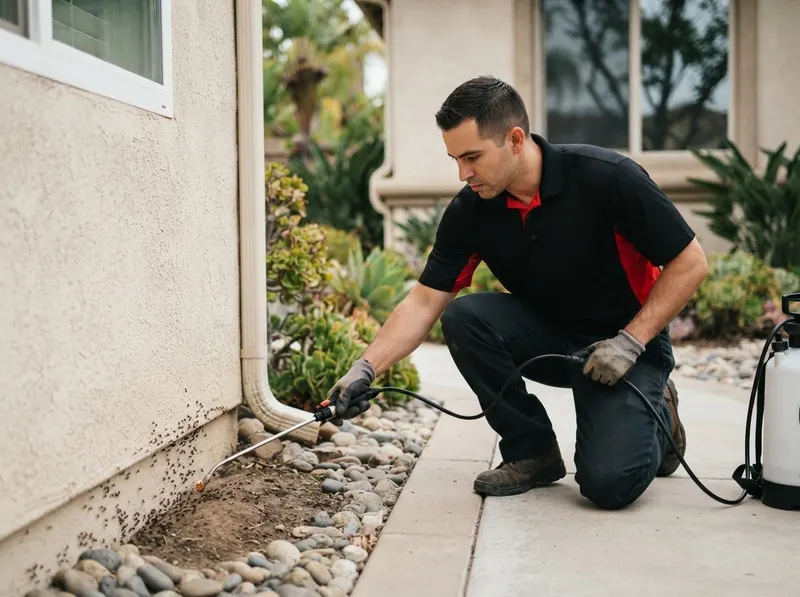
Argentine ant infestations throughout San Diego County present unique biological obstacles because the species forms massive, continuous networks known as supercolonies. Unlike native species governed by a single queen, a single mega-colony can contain thousands of fertile queens distributed across interconnected satellite nests. Homeowners in canyon-adjacent properties across Scripps Ranch and Clairemont frequently observe sudden, dense trails infiltrating kitchens and bathrooms during dry summer spells. Standard over-the-counter pyrethroid sprays trigger an alarm response called 'budding,' where surviving queens disperse to establish independent sub-colonies throughout interior wall voids. According to the UC Statewide Integrated Pest Management Program, effective suppression requires slow-acting horizontal transfer baits that foraging worker ants transport deep into subterranean galleries to feed the reproductive queens. Frontier Pest Management designs defensive perimeters specifically engineered to disrupt these coastal and inland canyon vectors without inducing nest division.
Terrain variables in coastal communities like La Jolla, Pacific Beach, Point Loma, and Ocean Beach accelerate ant incursions due to marine layer humidity coupled with sandy, friable soils. Sandy soil profiles permit rapid excavation along building foundations, concrete flatwork, and subterranean irrigation lines. Our field technicians execute structural diagnostics aligned with standards outlined by the California Department of Pesticide Regulation, mapping subterranean paths before initiating treatment. Liquid non-repellent applications adhere to the safety guidelines established by the U.S. Environmental Protection Agency, allowing foraging workers to unknowingly pick up undetectable active ingredients and pass them via trophallaxis across the entire colony network. Technicians inspect high-risk utility penetrations, weep screeds, and expansion joints where hardscape intersects structural stucco.
In older architectural pockets like North Park and Hillcrest, dense bungalow foundations and aged sub-slab plumbing lines create sheltered microclimates that shield ant colonies from summer soil desiccation. Field work aligns with structural safety protocols from the California Structural Pest Control Board, ensuring exterior perimeter applications do not drift onto unpaved drainage zones. When addressing infestations near canyon rims, such as those bordering Mission Bay Park, treatments follow the ecological management guidance of the California Department of Fish and Wildlife to protect local ecosystems. In areas adjacent to sensitive wildlife zones, including Torrey Pines State Natural Reserve and Cabrillo National Monument, non-repellent barriers are applied strictly within a five-foot structural band. Guidance provided by the County of San Diego Agriculture, Weights and Measures Department governs chemical handling limits, while run-off prevention measures adhere to water conservation rules established by the City of San Diego Public Utilities Department.
Frontier Pest Management balances systemic chemical transfer with exterior perimeter hardening. 1. Technicians survey property margins, mapping moist soil zones around drip lines and concrete retaining walls. 2. Field operatives deliver slow-acting indoxacarb matrixes that workers carry into deep subsurface chambers. 3. Specialized non-repellent liquid barriers coat the foundational stems up to 12 inches above the soil line. 4. Structural entry points, including weeping vents and utility raceways, undergo mechanical sealing. Homeowners with continuous moisture issues near historic sites like Old Town San Diego State Historic Park or properties near Petco Park can expect a multi-phase decline in trail density within three to seven days, avoiding the disruptive odors or chemical wash-off associated with non-targeted commercial spraying. Technical application safety complies with workplace run-off and operator benchmarks defined by the Occupational Safety and Health Administration and principles maintained by the National Pesticide Information Center.
Every job gets a firm, written price after a free on-site visit.
For standards, safe disposal, and service guidance on pest control services in San Diego, CA, useful references include U.S. EPA, ENERGY STAR, U.S. Dept. of Energy, Consumer.gov, U.S. Census Bureau, and Google Maps. General consumer and small-business resources are available from USA.gov, Better Business Bureau, FTC Consumer Advice, U.S. Small Business Administration, and Ready.gov.
Tell us about your argentine ant colony eradication job in San Diego and we'll send a clear, written quote, usually the same day.
 Frontier Pest Management