Properties flanking coastal canyons and inland maritime bluffs, from the Craftsman homes in North Park and Hillcrest to canyon-edge parcels in Clairemont and Scripps Ranch, suffer relentless seasonal rodent pressure.…
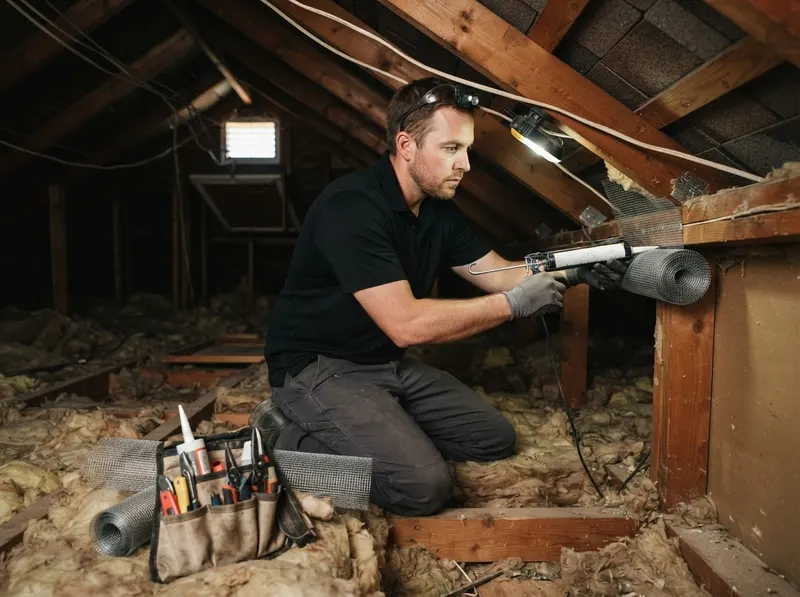
Properties flanking coastal canyons and inland maritime bluffs, from the Craftsman homes in North Park and Hillcrest to canyon-edge parcels in Clairemont and Scripps Ranch, suffer relentless seasonal rodent pressure. Coastal roof rats leverage overhead utility spans, eucalyptus canopies, and dense palm skirts to bypass surface treatments entirely, targeting attic ridge vents, rotted fascia boards, and crawlspace air vents. Standard monthly pesticide contracts simply apply broad repellent liquids that degrade quickly under marine fog; real protection requires structural mechanical exclusion. Sealing a residential building envelope demands materials engineered to withstand sustained gnawing, specifically galvanized 19-gauge steel hardware cloth, elastomeric masonry sealants, and custom metal flashing shaped precisely to sub-floor crawl vents and tile roof underlayments. Frontier Pest Management designs and installs these permanent defensive perimeters to restore home integrity without leaving off-gassing synthetic poisons inside living spaces.
Execution begins with a physical blueprint inspection that charts the primary thermal runways within attic cavities and dirt crawlspaces. Homeowners experiencing nighttime ceiling scratching or discovering shredded insulation alongside R-value degradations face structural wiring risks and electrical fire hazards documented by the National Fire Protection Association. Rather than distributing store-bought anticoagulants that create unretrievable carcass odors behind drywall, exclusion seals every void wider than 1/4 inch, adhering to physical barrier standards established by the Centers for Disease Control and Prevention. Foundation sill plates are sealed against Norway rat burrowing, and roofline dormers common in Point Loma, Ocean Beach, and Pacific Beach are fortified using rigid gauge wire fitted flush behind eave board intersections.
Deciding between targeted entry sealing and a total multi-surface exclusion depends on structural framing age and crawlspace ground clearance. Single-story post-and-beam configurations in La Jolla and Mira Mesa frequently present 20 to 30 linear feet of unscreened foundation air vents alongside disconnected HVAC chase voids. If air ducts have already suffered gnawing breaches, a combined structural repair and sanitation run is necessary; the trade-off involves a higher upfront mechanical expense against the perpetual cost of open-ended pest spraying agreements. Crawlspace ground barriers follow guidance from the U.S. Department of Housing and Urban Development for soil cover and moisture moderation, preventing damp harborages that attract wood-boring pests and rodents alike.
Regional building standards mandate maintaining active structural ventilation during exclusion work. The California Building Standards Commission specifies net free attic ventilation ratios under Title 24, meaning exclusionary screens cannot obstruct essential airflow necessary for attic cooling during dry inland Santa Ana wind patterns. Exclusion work must also align with local vector guidelines outlined by the San Diego County Department of Environmental Health and Quality to manage regional rodent-borne threats safely. Damaged insulation removal strictly follows worker safety and respiratory protection procedures managed by the California Division of Occupational Safety and Health. Biological sanitation utilizes non-hazardous biocides conforming to U.S. Environmental Protection Agency safety benchmarks, neutralizing pheromone trails without threatening household air quality. Homeowners facing sudden attic scratches or discovered crawlspace droppings can call (858) 206-2010 for dispatch diagnostics.
Every job gets a firm, written price after a free on-site visit.
For standards, safe disposal, and service guidance on pest control services in San Diego, CA, useful references include U.S. EPA, ENERGY STAR, U.S. Dept. of Energy, Consumer.gov, U.S. Census Bureau, and Google Maps. General consumer and small-business resources are available from USA.gov, Better Business Bureau, FTC Consumer Advice, U.S. Small Business Administration, and Ready.gov.
Tell us about your attic and crawlspace rodent exclusion job in San Diego and we'll send a clear, written quote, usually the same day.
 Frontier Pest Management