Food handling facilities in Hillcrest and North Park, alongside expansive distribution centers in Mira Mesa and Scripps Ranch, encounter intense insect and rodent pressure due to coastal microclimates and heavy…
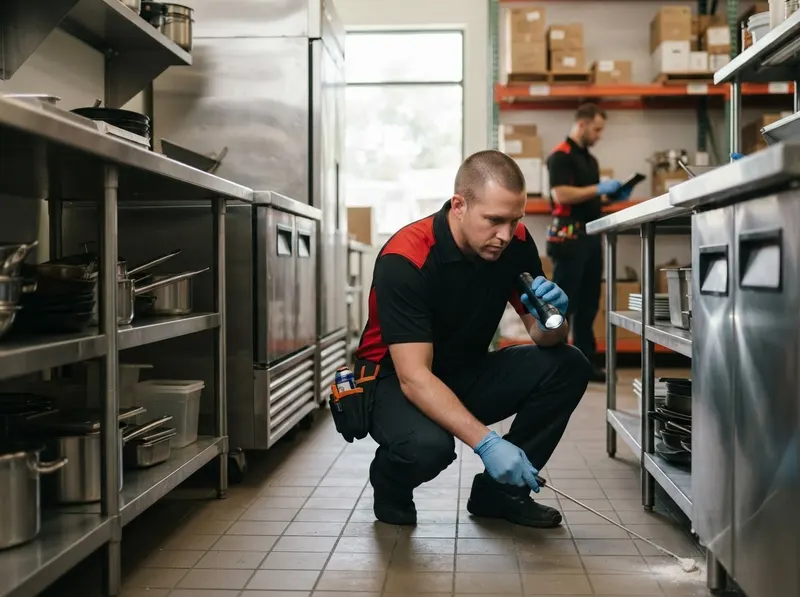
Food handling facilities in Hillcrest and North Park, alongside expansive distribution centers in Mira Mesa and Scripps Ranch, encounter intense insect and rodent pressure due to coastal microclimates and heavy municipal supply chains. Standard extermination practices often cycle routine pesticide sprays across baseboards, which fails to resolve nested colonies behind stainless steel wall cladding or inside motorized conveyor junctions. Structural defense demands rigorous containment built around biological realities. In commercial kitchens, moisture and grease accumulation create persistent harborage zones for German cockroaches (Blattella germanica) beneath cooklines and inside floor sink lines. Implementing enzymatic foams breaks down organic grease layers that shield larvae, neutralizing infestations before regulatory intervention by the San Diego County Department of Environmental Health and Quality. Warehouses require separate engineering protocols focusing on high-volume access vectors; overhead roll-up doors, dock levelers, and unsealed conduit lines serve as direct access paths for roof rats migrating along coastal canyon perimeters. Physical barriers, such as brush seals reinforced with galvanized steel mesh, prevent pest transit across threshold gaps larger than 0.25 inches.
Navigating sanitation standards requires alignment with federal enforcement mandates. Processing facilities must maintain unbroken documentation to satisfy food-contact surface regulations governed by the FDA Food Safety Modernization Act and insect carcass contamination standards enforced by the USDA. Frontier Pest Management implements non-volatile insect growth regulators and mechanical containment traps to eradicate target vectors without contaminating food prep surfaces or active processing lines, fully satisfying OSHA facility safety mandates and volatile organic compound restrictions established by the U.S. Environmental Protection Agency. For larger supply facilities operating adjacent to rail nodes or maritime routes near Point Loma and Pacific Beach, stored-product pests like the Indian meal moth necessitate focused pheromone monitoring arrays rather than broad-spectrum chemical fogs that trigger mandatory plant shutdowns.
Operational durability hinges on continuous mechanical integrity rather than chemical dependency. Standard consumer poisons applied by untrained staff introduce chemical resistance, run afoul of the California Department of Pesticide Regulation, and leave carcasses to decay inside wall cavities, causing secondary dermestid beetle outbreaks. A commercial kitchen that measures 2,000 square feet requires dense localized monitoring behind dish machines and refrigeration compressors, whereas an 80,000-square-foot warehouse in an inland valley environment requires perimeter bait shielding, ultrasonic sensor tracking, and roof-line exclusion to prevent avian nesting under structural eaves. Structural modifications, such as filling expansion joints with elastomeric sealant and installing 40-mesh stainless screens over roof vents, permanently close the building envelope against pest ingress.
Every job gets a firm, written price after a free on-site visit.
For standards, safe disposal, and service guidance on pest control services in San Diego, CA, useful references include U.S. EPA, ENERGY STAR, U.S. Dept. of Energy, Consumer.gov, U.S. Census Bureau, and Google Maps. General consumer and small-business resources are available from USA.gov, Better Business Bureau, FTC Consumer Advice, U.S. Small Business Administration, and Ready.gov.
Tell us about your commercial kitchen and warehouse pest defense job in San Diego and we'll send a clear, written quote, usually the same day.
 Frontier Pest Management